


Measures
The measures of Indigenous Early Relational Wellbeing Practices - Family (IERWP – Family) and Indigenous Early Relational Wellbeing Practices - Early Childhood Practice (IERWP – ECP) were developed by the Tribal Early Childhood Research Center (TRC) for families with young Native children prenatal to age 5 and for early childhood educators of Native children prenatal to age 5. The purpose of these measures is to understand practices that support Indigenous early relational wellbeing (ERW) and young children’s connections to family, multiple generations, community, and the environment.
Response Scale
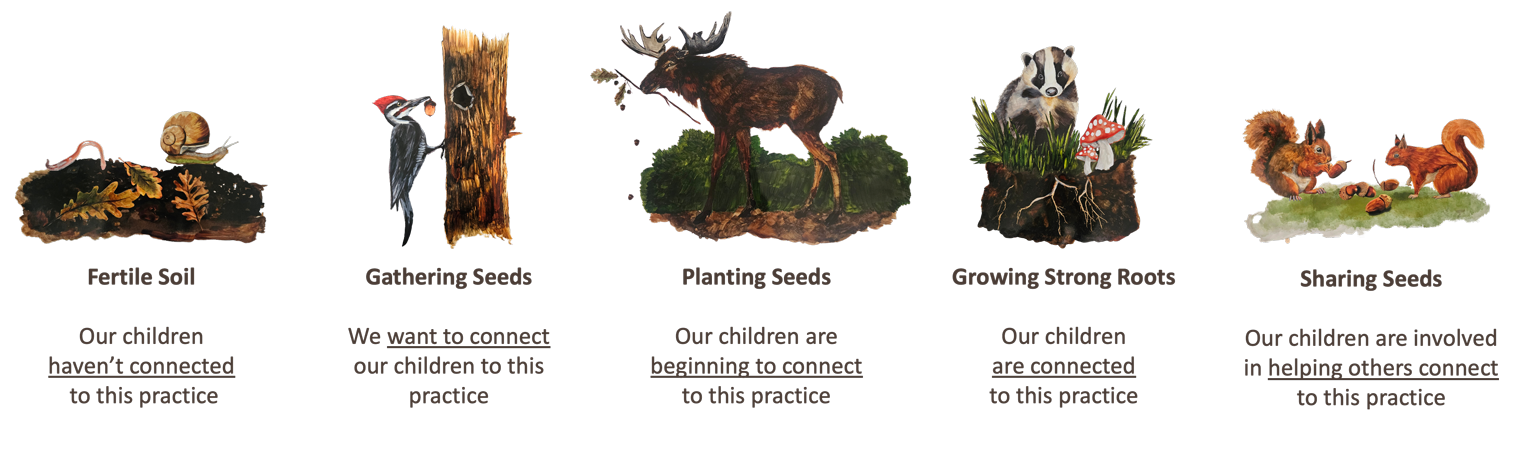
The measures ask families and early childhood educators to answer questions based on a visual response scale from ‘Fertile Soil’ to ‘Sharing Seeds.’
| Response Option | Description |
|---|---|
| Fertile Soil | Our children haven’t connected to this practice |
| Gathering Seeds | We want to connect our children to this practice |
| Planting Seeds | Our children are beginning to connect to this practice |
| Growing Strong Roots | Our children are connected to this practice |
| Sharing Seeds | Our children are involved in helping others connect to this practice |
Place-based Options
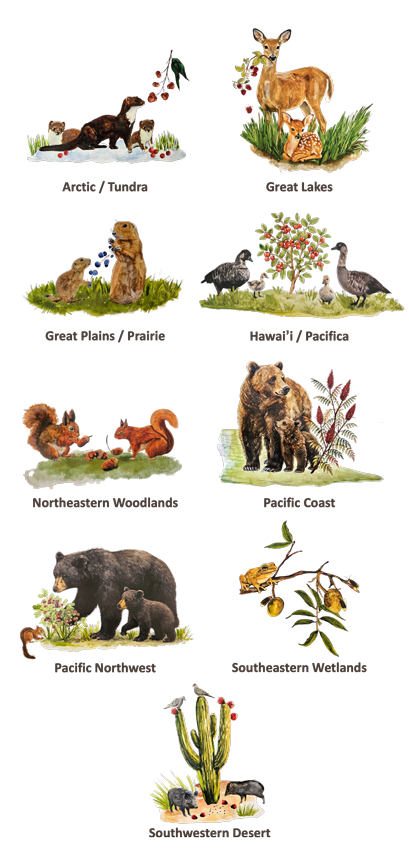
In the development of this visual response scale, we worked with Chiffon Lark, Indigenous artist, illustrator, and children’s book author, to develop place-based options for programs to choose from. Each option reflects diverse regions and ecosystems using the ‘seeds of connectedness’ metaphor. Below are the current place-based options, all of which can be mixed and matched to best fit local programs and communities.
- Arctic Tundra
- Great Lakes
- Great Plains / Prairie
- Hawaii / Pacifica
- Northeastern Woodlands
- Pacific Coast
- Pacific Northwest
- Southeastern Wetlands
- Southwestern Desert
The measure of Indigenous Early Relational Wellbeing Practices – Family (IERWP – Family) was developed by the TRC for families with young Indigenous children prenatal to age 5. The measure was developed to help understand practices that support early relational wellbeing and young children’s connections to family, multiple generations, community, and the environment.
The IERWP – Family measure includes 82 items across seven subscales, which capture different dimensions of Indigenous early relational wellbeing. Family members are asked to consider each practice and how their child(ren) is(are) connected to the practice. The measure uses a strengths-based visual response scale grounded in a ‘seeds of connectedness’ metaphor. This imagery helps family members to reflect on where their child is on their journey in connection to each practice.
Subscales
Practices are organized into 7 groups (or subscales):
- Cultural foods (7 items)
- Land and environment (11 items)
- Everyday activities (12 items)
- Family and community (6 items)
- Birth and early child care (12 items)
- Cultural identity and spirituality (19 items)
- Cultural knowledge (16 items)
IERWP – Family Survey Options
Below are the current versions of the IERWP – Family Survey. Each survey includes a visual response scale representative of that region/place. The response scale can be tailored or mixed and matched to best fit local programs and communities.
- IERWP-Family Survey – Arctic Tundra
- IERWP-Family Survey – Great Lakes
- IERWP-Family Survey – Great Plains / Prairie
- IERWP-Family Survey – Hawai'i / Pacifica
- IERWP-Family Survey – Northeastern Woodlands
- IERWP-Family Survey – Pacific Coast
- IERWP-Family Survey – Pacific Northwest
- IERWP-Family Survey – Southeastern Wetlands
- IERWP-Family Survey – Southwestern Desert
Want to make your own changes to the measure?
>>Download a folder with the Word version of each of the IERWP-Family survey options
The Indigenous Early Relational Wellbeing Practices – Early Childhood Practice (IERWP – ECP) was adapted from the original IERWP – Family measure and was designed for early childhood educators of Native children aged 5 and younger who work within Tribal Child Care, Head Start, and other early childhood care and education settings.
The IERWP – ECP measure assesses 70 relational practices that may be used by early childhood educators to support the early relational wellbeing of children age 0-5 enrolled in Tribal early childhood education and care programs. The measure asks early childhood educators to describe how children are exposed to each practice in their care setting.
Subscales
Practices are organized into 6 groups (or subscales):
- Connections to Cultural Foods & Practices (8 items)
- Connections to Land & Environment (11 items)
- Connections Through Everyday Activities (12 items)
- Connections with Family & Community (6 items)
- Connections Through Cultural Identity & Spirituality (17 items)
- Connections Through Cultural Knowledge (16 items)
IERWP – ECP Survey Options
Below are the current versions of the IERWP – ECP Survey. Each survey includes a visual response scale representative of that region/place. The response scale can be tailored or mixed and matched to best fit local programs and communities.
- IERWP-ECP Survey – Arctic Tundra
- IERWP-ECP Survey – Great Lakes
- IERWP-ECP Survey – Great Plains / Prairie
- IERWP-ECP Survey – Hawai'i / Pacifica
- IERWP-ECP Survey – Northeastern Woodlands
- IERWP-ECP Survey – Pacific Coast
- IERWP-ECP Survey – Pacific Northwest
- IERWP-ECP Survey – Southeastern Wetlands
- IERWP-ECP Survey – Southwestern Desert
Want to make your own changes to the measure?
>>Download a folder with the Word version of each of the IERWP-ECP survey optionsChiffon Lark
Chiffon Lark (White Mountain Apache/Mescalero Apache & Coahuiltecan ) is a Southern California based Native American Artist & Author, who specializes in Children’s Literature and Wildlife Illustration. Her recent self-authored and self-illustrated publication, I Am (2025), has served as an indigenous language revitalization initiative as well as providing a minimalist approach focusing on internal emotional growth through indigenous wisdom concepts. Chiffon is an environmental advocate who uses illustrative narrative to establish awareness of human relationships between wildlife and complex ecosystems. She has worked with Tribal and Non-Tribal Organizations/Initiatives throughout the United States and South America, using her art to support environmental preservation and education.
See her work at: www.chiffonlark.com
Follow her on Instagram: @chiffonlark